.webp)


Summary: Key Takeaways
- A CPG marketing agency helps brands translate marketing strategy into execution across crowded, high-stakes channels like retail, DTC, experiential, and brand storytelling.
- Many top agencies don’t replace internal teams; they extend them, especially in moments that require creative lift, speed, or specialized expertise.
- Experiential marketing and brand activation–led agencies play a critical role when brands need to build emotional connections, not just impressions.
- Hiring the right CPG marketing agency is less about “outsourcing marketing” and more about de-risking growth decisions.
- In addition to year-round campaigns, brands can benefit from a CPG marketing agency during launches, inflection points, channel expansion, or when internal teams are stretched thin.
CPG brands face a uniquely difficult challenge: building product demand and brand trust in environments where consumer and retailer attention is fragmented, shelf space is limited, and the competition is relentless.
That’s why many brands partner with a CPG marketing agency, whose scope is often different from traditional marketing firms to create unique value.
In this article, we’ll walk through:
- What a CPG marketing agency truly does
- How experiential marketing fits into the CPG ecosystem
- When hiring an agency makes sense and when it doesn’t
- When agencies support internal teams instead of replacing them
What Is a CPG Marketing Agency?
At its core, a CPG marketing agency helps consumer packaged goods brands grow awareness, trial, and repeat purchase across physical and digital environments.
Unlike general marketing agencies, CPG-focused firms understand:
- Retail dynamics and sell-through pressure
- Short decision cycles at shelf
- The importance of packaging, placement, and experience
- The reality of omnichannel attribution gaps
A strong CPG marketing agency connects brand strategy, creative execution, and real-world activation, not as isolated services, but as an ecosystem.
.png)
The Core Functions of a CPG Marketing Agency
While offerings vary, most CPG marketing agencies support brands across five core areas:
1. Brand Strategy & Positioning
CPG marketers know that before campaigns, brands need a clear roadmap that aligns to business objectives. Agencies help brands answer questions like:
- What problem do we solve for the consumer?
- Why should consumers choose us over other options in the market?
- How do we show up consistently across touchpoints?
This work often includes:
- Brand audits
- Competitive mapping
- Messaging frameworks
- Go-to-market alignment
FAQ: Do most internal product teams lead brand strategy?
Not always. Many brands prefer to hire agencies to lead on brand strategy due to their external perspective and pattern recognition across the category, which helps avoid internal blind spots and can make marketing campaigns, particularly experiential ones, more impactful.
2. Experiential Marketing & Brand Activation
Brand activation is a key area where experiential-led CPG marketing agencies differentiate themselves.
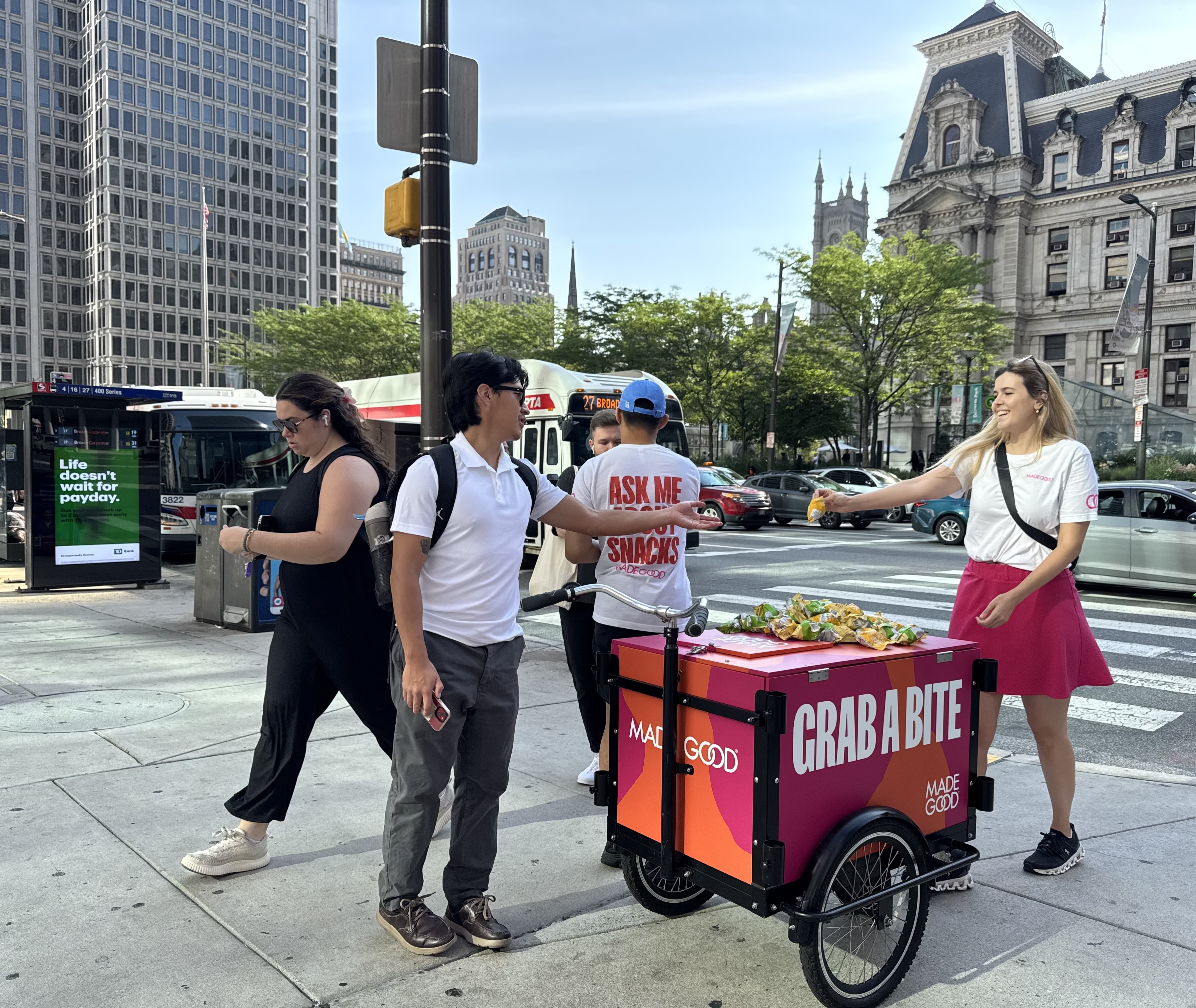
Experiential marketing brings CPG brands to life through:
- Sampling programs
- Pop-ups and mobile tours
- Retail takeovers
- Event integrations
- Community-driven activations
For CPG brands, this isn’t about spectacle. It’s about trial, memory, and driving purchase.
FAQ: Does experiential marketing still matter in a digital-first world?
Absolutely, especially for CPG. Physical experiences drive product trial, social sharing, and downstream digital performance, in addition to increasing purchase rates.

3. Campaign Creative & Social Media
CPG marketing agencies help brands develop creative that works across:
- Paid media
- Retail environments
- Social media
- Influencer and creator channels
- IRL moments that generate content loops
The focus isn’t just on assets. It's an omnichannel experience that scales creative efficiently.
FAQ: Do agencies replace in-house creative teams?
The best agencies don’t replace teams; instead they augment them during high-demand periods or specific campaigns.
4. Retail & Shopper Marketing Support
Many CPG marketing agencies support:
- In-store programs
- POS materials
- Retail promotions
- Trade marketing alignment
- Shopper journey optimization
This work requires an understanding of how consumers actually behave in-store, which can be different from online behavior.
FAQ: Is shopper marketing still relevant as DTC grows?
Absolutely. For most CPG brands, retail remains the largest revenue driver and the most competitive battlefield.
5. Measurement, Learning, and Optimization
CPG marketing doesn’t benefit from false precision.
Strong agencies focus on:
- Directional learning
- Test-and-learn frameworks
- Lift analysis
- Qualitative insights alongside quantitative data
This creates momentum without over-engineering attribution.
FAQ: Can experiential marketing be measured effectively?
Yes, and the best CPG marketing agencies will partner with brands to identify metrics that matter across consumer engagement and downstream impact.
Where Experiential-Led CPG Marketing Agencies Add the Most Value
Not every agency is built the same. Experiential-led CPG marketing agencies are most valuable when brands need to:
- Launch a new product or line
- Enter a new market or channel
- Re-energize a mature brand
- Build emotional connection, not just reach
- Turn awareness into trial
These moments are high-risk and high-impact, and they require expert-led campaign design to reach goals.
When Does a Brand Actually Need a CPG Marketing Agency?
In our experience, brands benefit most from a CPG marketing agency when:
- Internal teams are stretched thin
- Stakes are high (launches, pivots, new channels)
- Specialized expertise is required, especially in experiential marketing
- Objectivity is needed to cut through internal bias
- Creative fatigue is setting in
Agencies are most valuable when they reduce decision risk, not when they simply add output.
How a CPG Marketing Engagement Typically Works
Transparency matters. Here’s what a well-run agency engagement usually looks like.
Step 1: Discovery & Context Building: The agency learns the brand, category, constraints, and goals, including what’s already been executed and what campaigns are underway.
Step 2: Strategic Framing: Opportunities are defined clearly, with tradeoffs explained.
Step 3: Concept Development: Creative ideas are developed with execution realities in mind.
Step 4: Activation & Execution: Programs are launched with operational rigor and flexibility.
Step 5: Learning & Optimization: Results are documented, insights extracted, and recommendations shared. The emphasis is on education and clarity, not mystery or black boxes.
Common Mistakes Brands Make When Hiring a CPG Marketing Agency
Some patterns we see repeatedly:
- Choosing based on hype, not fit
- Overvaluing channel expertise and undervaluing strategy
- Expecting agencies to “fix” structural issues
- Treating agencies as vendors instead of partners
The right agency relationship feels collaborative, grounded, and honest — even when conversations are difficult.
Final Thoughts
A CPG marketing agency, at its best, helps brands:
- See clearly
- Act confidently
- Learn faster
- Reduce risk during critical moments
If this article was helpful, share it with someone on your team who’s navigating agency decisions right now.
If you’re exploring how experiential marketing or brand activation could support your next growth phase, we’d love to connect.
Contact us to Book Your Discovery Call
People Also Ask
What does a CPG marketing agency specialize in?
They specialize in consumer behavior, retail dynamics, brand experience, and omnichannel execution specific to packaged goods.
Is experiential marketing effective for CPG brands?
Yes. Experiential drives trial, memory, and emotional connection — all critical for repeat purchase.
How much does a CPG marketing agency typically cost?
Costs vary widely based on scope, activation complexity, and duration. Transparency matters more than price alone.
Can a CPG marketing agency work alongside internal teams?
The strongest agencies are designed to integrate seamlessly with internal teams and other partners.
What should a CMO look for in a CPG marketing agency?
Clarity of thinking, category experience, operational discipline, and a collaborative mindset.